

Hello to you in 2026! I hope it brings even more joy, growth, and inspiration than the year just gone. Whatever goals you’ve chosen for yourself for this year, remember that the journey is just as important as the destination.
This year is looking very busy for me in terms of teaching, but I still hope to keep adding new materials to Three Wise Kangaroos. Since the start of the year I’ve had quite a lot of enquiries about the IELTS exam which has given me an idea for this post.
In Australia I specialise in exam preparation classes. IELTS is a trusted English test accepted by the Australian government, and it remains a key option for visas, study and work Down Under. There are two versions of the exam IELTS Academic – for study or professional registration and IELTS General Training – typically for migration and work purposes. One of the things both exams have in common is Writing Task 2 – they both require the candidate to write an essay on a given topic.
I find that one of the greatest challenges for many students is achieving Band 7 or higher in Writing Task 2. One of the biggest difficulties lies in developing a strong lexical resource and using linking language effectively. Even well-structured essays often fail to reach a higher band score due to limited vocabulary range or repetitive, basic connectors.
While there is no shortage of IELTS preparation websites offering past exam questions and model answers, there appears to be a noticeable lack of useful vocabulary practice, particularly in the form of ready-made worksheets and targeted word lists.This has inspired me to create and share a series of ready-made resources designed specifically to help learners improve their IELTS Writing Task 2 vocabulary and cohesion. These materials aim to bridge the gap between knowing how to write an essay and writing one at a Band 7+ level. So let’s dig into the nitty-gritty of Writing Task 2.
1. Use synonyms
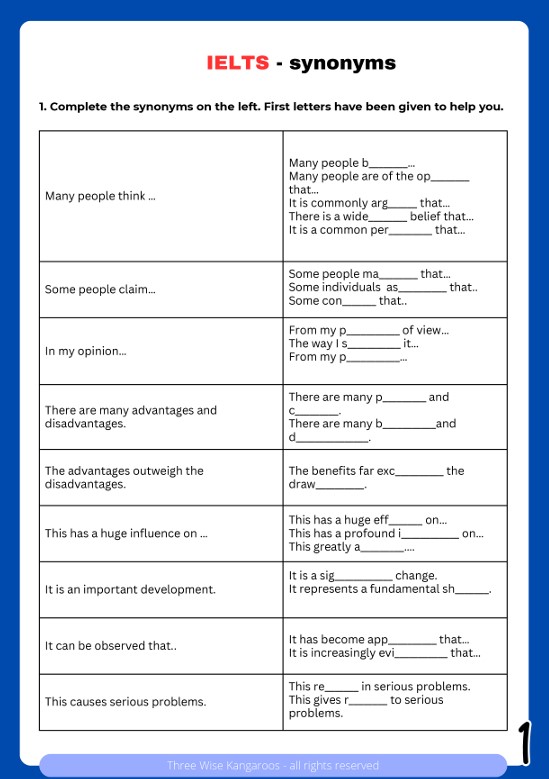
No matter what type of IELTS essay you are writing, using synonyms effectively is essential if you want a high band score. Right from the introduction – where you need to paraphrase the question clearly – you should aim to vary your language throughout the essay. This not only helps you to avoid repetition, but also shows the examiner that you can express the same idea in different ways naturally and confidently.
Here’s a copy of useful phrases and their synonyms you will be able to apply in the various IELTS essay types and topics. How many of the gaps can you fill in? Refer to the answer key for solutions and keep this worksheet handy while you’re practising your writing.
This content is available to registered users only.
Register or log in now.
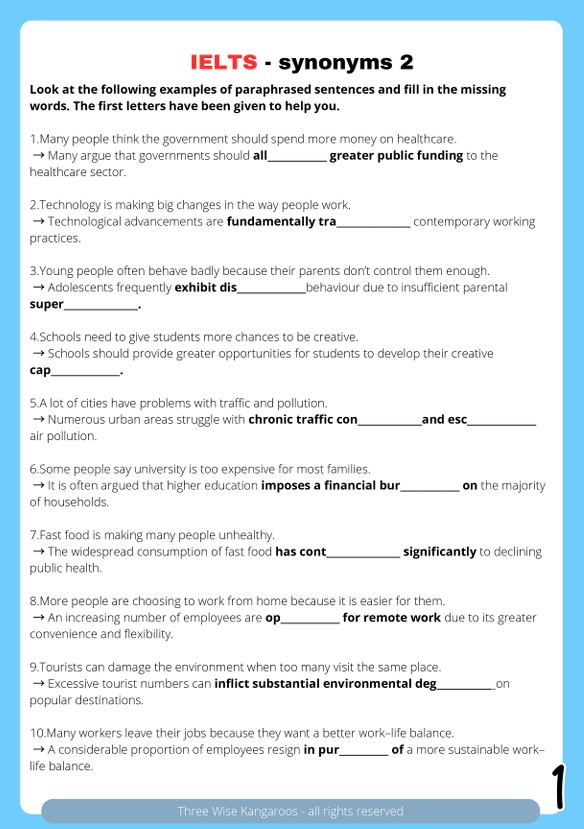
Here’s another worksheet I put together to help you practise the art of expressing the same idea in a different way. Can you rewrite the sentences using the clues given while keeping the same meaning?
This content is available to registered users only.
Register or log in now.
2. Learn natural collocations
Using natural collocations in IELTS Writing Task 2 is important because they show the examiner that you can use English the way native speakers do, not just that you know individual words. This directly improves your Lexical Resource score, as natural word combinations make your writing sound fluent, precise, and less ‘translated’.
In contrast, unnatural collocations (e.g. make pollution instead of cause pollution) can reduce clarity and signal limited language control, even if the ideas are good. Correct collocations help you express ideas accurately and efficiently, which also supports higher scores in Coherence and Grammar.
Compare:
- Basic: ‘The government should help poor people.’
- Advanced: ‘The government should provide financial assistance to low-income households.’
Look at some other examples of advanced collocations:
- pose a threat to…
- play a vital role in…
- address the root cause of…
- a growing body of evidence suggests…
- be widely regarded as…
- implement effective measures to…
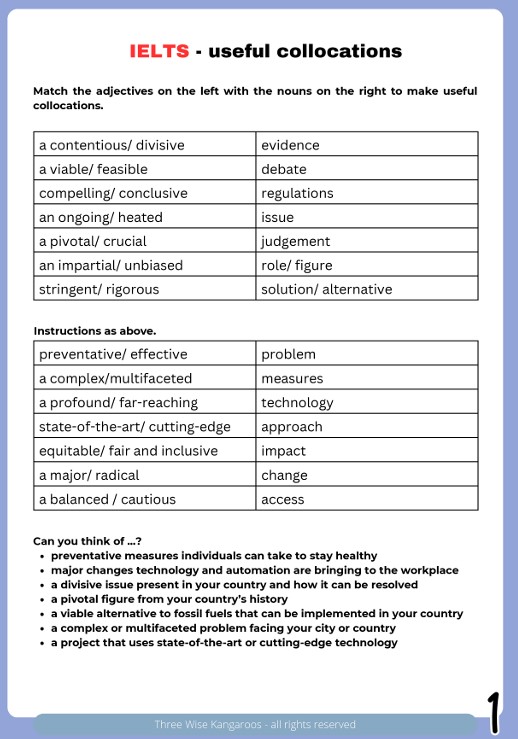
Have a go at this exercise and see how many collocations you know. Make a list of 10 you’d like to learn and try to apply them in your writing.
This content is available to registered users only.
Register or log in now.
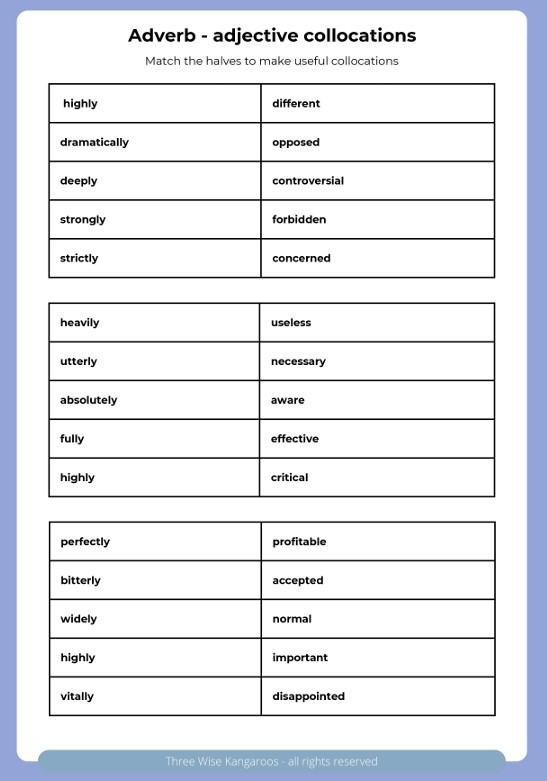
Another way to lift your score through collocations is to modify your adjectives using adverbs.
Compare:
- Basic: ‘It is a controversial subject. People are opposed to the idea’
- Advanced: ‘It is a highly controversial subject. People are strongly opposed to the idea.’
Have a look at some other adverb+adjective collocations here:
This content is available to registered users only.
Register or log in now.
3. Create a vocabulary bank
Creating a vocabulary bank for different IELTS topics is a good idea because it helps you prepare smarter, not harder. Instead of memorising random words, you build a set of relevant, topic-specific vocabulary and collocations that you can confidently use in the exam.
Time to have a look at some examples of IELTS writing exam task 2 and practise using the collocations in context. For every topic, try to create a vocabulary bank and think of what other collocations/ advanced phrases you could use.
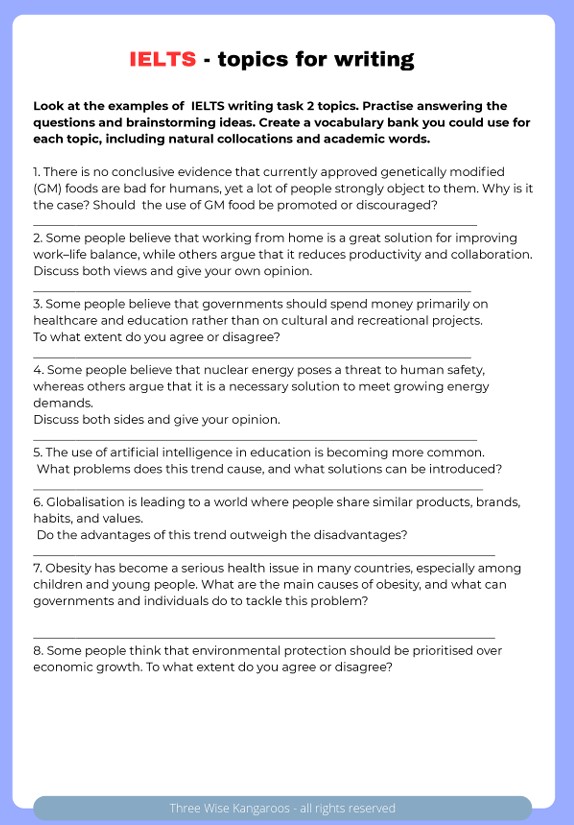
This content is available to registered users only.
Register or log in now.
If you would like to further practice vocabulary and natural collocations connected with various themes in a structured manner, our Vocabulary and Conversation Booster ( Part 1, Part 2, Part 3, Part 4 ) series together withEnglish at Work andEnglish for Travel will serve the purpose. They contain stacks of lexical practice that will help you prepare for the many topics IELTS questions relate to such as:
- Work
- Travel
- Food
- Money
- Science
- Cities
- House and home
- The environment
- Entertainment
- Medicine
- Crime and Punishment
- and many more
4. Improve your linking
Linking devices are important in IELTS because they help your ideas flow logically and clearly, making your writing easy for the examiner to follow. They show that you can organise information effectively, which directly improves your Coherence and Cohesion score.
Without clear linking words, even good ideas can feel disconnected or confusing. Using linking devices appropriately (not excessively) demonstrates control over academic writing and helps you present arguments in a structured, high-band manner. Here’s a worksheet that will help you practise the various linking devices.
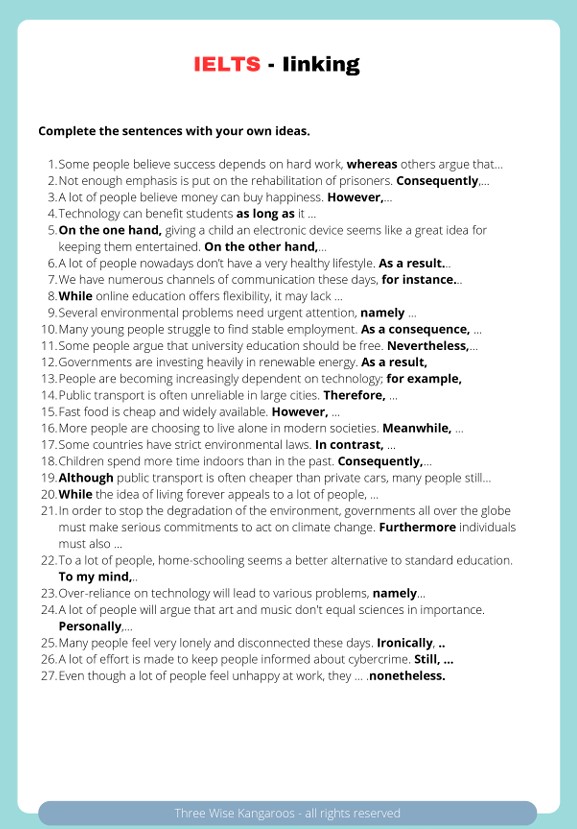
This content is available to registered users only.
Register or log in now.
5. IELTS preparation with Gaby
If, despite all the resources and information available online, you still feel confused about the IELTS exam and how to prepare best, get in touch. I have been successfully preparing students for years and can help you:
- identify your strengths and weaknesses
- master the exam format and assessment criteria
- create a personalised study plan tailored to your goals
- learn practical strategies for each section (Listening, Reading, Writing, Speaking)
- improve time management under exam conditions
- practise with real IELTS-style questions and get feedback
- stay accountable, motivated, and consistent in your preparation
At first glance, the IELTS exam can feel overwhelming, and understanding the format and scoring criteria may seem daunting. However, when a professional IELTS trainer breaks it down into clear, manageable steps, the process becomes straightforward, and your goals suddenly feel achievable.
So feel free to drop me a message and I will do my very best to help you achieve your band score:
In the meantime, happy studying, and may all your hard work pay off with the band you’re aiming for!
Till next time,
Gaby